Showing posts with label New York. Show all posts

Wednesday, May 1, 2013

Hurricane Sandy Relief Funds Might Not Be Used to Rebuild Homes


Six months after Hurricane Sandy made landfall, property owners are still struggling with the costs of repairs, and it was recently discovered that New York City residents might not be allowed to use federally granted funds to rebuild their homes. 

New Yorkers still have a hurdle to overcome with regard to funding for hurricane repairs and renovations: federal relief money disbursed to private citizens can only be used to build new structures, not restore damaged ones.[1] However, no such restrictions are given to Long Island residents, even though the amount of money being given to the districts is almost the same (New York has been allotted $1.8 billion; Long Island $1.7billion). The funding for structural repair is desperately needed, since many of the severely damaged homes will have to be not only repaired, but elevated as well, in accordance with new flood safety standards.[2]


The lack of consistency with regard to how monies can be used within a single state is causing consternation among not only New York City residents, many of whom are still not able to move back into their homes, but also among state and local officials. Senator Chuck Schumer wrote in a letter to Housing and Urban Development Secretary Shawn Donovan that there must be uniformity with regard to relief funding for all residents of New York State. “A homeowner in Rockaway Beach will not be eligible for the same benefit that a homeowner in Long Beach, just 10 miles away, will be able to access."

The New Yorkers without flood insurance who are looking to repair their homes and businesses might have reason for hope, however, since the plans for the allotment of funds are “only preliminary,” according to a spokesperson for the City.

It was announced that residents who were still unable to inhabit their homes would be moved from Federal Emergency Management Agency-funded hotels into temporary apartments. FEMA would pay the rental, as well as administrative, costs for the initiative.

Any funding for rebuilding efforts will certainly come in handy, considering that many residences will have to be elevated in order to comply with the new safety standards. The price of elevating a structure is steep—between $10,000 and $100,000, not including the cost of any other related expenses, such as a new foundation. Nevertheless, certain structures lying within the current advisory flood maps will be required to be elevated. Others outside of the flood area will not necessarily have to be elevated, but homeowners will have to decide whether to bear the costs of elevation or contend with substantially higher insurance rates.


[1] Hurricane Sandy relief rules restrict New Yorkers from  using cash to rebuild 4/11/2013 http://rt.com/usa/sandy-relief-federal-restrictions-662/
[2] Harris, Elizabeth: Going Up a Few Feet, and Hoping to Avoid a Storm’s Path New York Times 4/15/2013 http://www.nytimes.com/2013/04/16/nyregion/after-hurricane-sandy-homeowners-elevate-property.html?pagewanted=all&_r=0

Wednesday, January 2, 2013

Mental Health Facilities Post Hurricane Sandy

New York City's Mental Health Resources

Among all of the facilities that were taxed by the landfall of Hurricane Sandy, New York City’s mental health resources are possibly the most dangerously overburdened. Many of the hospitals dedicated to the care of individuals with severe mental disorders were either destroyed or rendered uninhabitable by the storm, and officials are struggling to house and treat the many thousands of people suffering from mental conditions that render them unable to care for themselves.

The recent subway assaults highlighted the need for (and absence of) adequate mental health resources. In the past month, two people were killed after being shoved in front of oncoming trains by people with histories of severe mental health issues. In early December, 2012, Naeem Davis, a homeless man, stated that the voices in his head encouraged him to push the victim, Ki-Suck Han, in front of a moving train. Only a few weeks later, another man was fatally pushed in front of a moving train by a Erika Menendez, a woman who was reported to have been in and out of mental health institutions for the past nine years, and had a series of criminal charges against her for assault.

Many Outpatient Facilities Forced to Close Once Storm Hit

Before the hurricane, mental health facilities were straining to provide sufficient services for the thousands of people suffering from mental illnesses that prevent them from leading healthy, independent lives. However, after the storm hit, many outpatient facilities had to be closed, and the patients inhabiting them were relocated to different shelters throughout the city, many of them ill equipped to handle the wide variety of psychoses. The stress of the hurricane also caused patients to relapse into their paranoid delusions, and distributing the proper medications became difficult.

Psychiatrists are seeing dangerously ill patients being released only hours after admittance. There were plans underway to expand provisions for the mentally ill before the hurricane, but those plans are now woefully insufficient to meet the demand. The confusion after the storm has caused many of the patients housed by closed psychiatric hospitals to scatter, with their caseworkers and families struggling to locate them. While many of the patients were relocated to other facilities and shelters, those shelters are not equipped to accommodate the severely mentally ill, and some patients were later found living in deplorable conditions.

The safety and well being of entire communities are in jeopardy by the failure to provide appropriate care for the mentally disturbed. The two subway deaths are horrible examples of what can befall a society without the appropriate resources to care for the ill. Hopefully, health officials will recognize the desperate need for sufficient care, and allocate funds for that purpose.

Wednesday, December 19, 2012

Hurricane Sandy Charitable Efforts

Hurricane Sandy Aftermath Brings People Together

The Hurricane Sandy aftermath has caused people to come together and help victims in creative ways. Recently, a group of celebrities participated in a relief concert that was broadcast live all over the nation—the 12-12-12 concert—and $50 million of the raised funds were distributed through the Robin Hood Foundation. The first wave of funds came from telephone donations, ticket sales, merchandise sales and sponsorships. Music downloads, DVD/CD sales and auctions of signed merchandise and memorabilia will make up the rest of the donations.

The cream of the entertainment industry crop is often front and center with united efforts to solicit charitable donations during huge natural disasters. Hurricane Katrina and the devastating earthquake in Haiti also galvanized Hollywood’s best and brightest for a night of fundraising and music.

Other Hurricane Sandy Charitable Efforts

However, celebrities certainly aren’t alone in their charitable efforts. There is also an auction taking place on December 19th for Hurricane Sandy relief, wherein furnishings, art and décor fashioned from Hurricane Sandy debris will be sold. The pieces include table tops, lighting fixtures, wall art and chairs—all made from trash! The artists and designers participating in this auction are called Reclaim NYC.

Right after the worst of the hurricane, hot dog carts, taco vendors and burger trucks stationed themselves amid the worst of the wreckage, in the neighborhoods without power. The company Domino Sugar donated more than 30,000 pounds of products, including sugar, coffee, and powdered beverages to victims.

Wadena-Deer Creek Elementary School Pajama Drive

With the Christmas season quickly approaching, many families will lack the resources to provide their kids with even a home to call their own, let alone toys and gifts. In the spirit of the season, students at Wadena-Deer Creek Elementary School held a pajama drive so that kids could get warm pajamas and books this Christmas.

Creativity is Key in Charitable Efforts

While it is important to continue channeling money and goods to all of the different organizations dedicated to helping the storm victims, it is also important to maintain a creative spirit when looking for solutions. Having different drives, auctions and concerts helps keep the altruistic fires stoked, and also helps people who might believe that they don’t have a voice contribute to the efforts. My brother Michael Omidi and I applaud all of the different ways people have decided to step up and help all of the communities that were forever altered by this terrible hurricane, and we hope that the spirit of generosity continues until everyone suffering from deprivation finally has a comfortable home again.

Thursday, November 29, 2012

Hurricane Sandy Accelerates Temporary Housing Plans

Federal Officials Accelerate Plan to Create Disaster Housing Structures

Because the Hurricane Sandy disaster highlighted the nation’s lack of a contingency plan in the wake of a natural disaster, both federal and local east coast officials accelerated a plan to create disaster housing structures, which are to be temporary units that can be stacked and stored in warehouse spaces and then assembled quickly when needed. These units will be fabricated from shipping and storage containers. Instead of disbursing people whose homes were destroyed into temporary shelters or hotel rooms, the city would quickly assemble temporary neighborhoods.


While the temporary housing units will not be available for use by the victims of Hurricane Sandy, it is anticipated that a prototype will be ready for construction sometime next year. The shipping containers are approximately 40 x 12 x 9 feet, and can accommodate one bedroom and bath, a kitchen and living room. These units can be combined for large families, and even stacked in order to create entire apartment blocks, as well as arranged in such a way as to suggest a proper neighborhood.

Emergency Shelters

New York’s current Hurricane Sandy relief efforts involved distributing newly homeless residents to emergency shelters in high schools and colleges, moving them to dormitory style armory shelters when the schools reopened, and then finally installing them in hotel rooms around the city. Shelters that were originally imagined for victims of substance abuse were also used, but these were not equipped for families with infants. The new plan will prevent the current permanent homeless shelters, already stretched beyond capacity, to continue to function without added strain, and to keep unoccupied apartments set aside for those who need permanent housing.
The Commissioner for New York’s Department of Design and Construction says that these storage units are strong, weather resistant and fairly cheap. The structures will be distributed to the hardest hit areas of a natural disaster, remain while the homes are being rebuilt and then dismantled and stored again after the residents have been reestablished in permanent residencies. Each unit is estimated to cost between $50,000 and $80,000, and will be paid for by the Federal Emergency Management Agency and New York City. The original idea for these homes came from a New York-sponsored design contest, and the temporary modular housing concept has been in development for five years.

Unlike the old FEMA trailers which had a very limited lifespan, the shipping container housing units are thought to be durable enough to be reused again and again; the shipping containers themselves can be reused up to 20 times and will last as long as 30 years.

Tuesday, November 27, 2012

Superstorm Sandy Leaves NY Homeless Devastated

Superstorm Sandy Devastates NY City's Homeless Population

The homeless population of New York City was more than what the public facilities could handle before Hurricane Sandy; today the resources have been stretched farther than anyone could have imagined.

Before the storm, New York had more than 47,000 chronic homeless being - sheltered—more than any other US city. Advocates for the homeless have waged battles with the city to open up affordable housing opportunities in the thousands of “warehoused” properties in the boroughs of Manhattan and Brooklyn. “Warehousing” is a legal practice wherein property owners allow their residential buildings to sit, unoccupied, until property values rise and the rents go up. It is estimated that the more than 3500 vacant buildings in New York could house upwards of 70,000 people, while the nearly 2500 vacant lots could be developed into housing for more than 100,000.

Temporary Resident Struggle to Find Shelter

The rise of newly homeless after Hurricane Sandy caused a frenzy of activity in order to create enough shelter space for everyone whose homes were no longer habitable. Schools and college campuses were turned into hastily constructed evacuation centers in order to provide safe havens, but had to be dismantled in order to resume classes, so many of the evacuees were distributed to armories, where dormitories had been temporarily installed. Others were shuttled to Samaritan Village shelters, which were designed to house substance abusers. Many facilities had no provisions for children and babies. Others had to sequester the mentally unstable chronically homeless from the rest of the population. Now, most of the residents of these temporary shelters have been relocated to local hotels, but because many no longer have jobs or sources of income, it is unclear where the temporary residents will go after the hotel rooms are no longer being paid for.


Distinction between homeless population and terminal homeless

The Commissioner for the Department of Homeless Services declared that there is a distinction made between the homeless population that resulted from Hurricane Sandy and the terminal homeless. The shelter standards that were in place to address the homeless population before Hurricane Sandy do not apply to centers for the “temporarily” homeless. However, now that the hurricane victims have been moved and the scope of the problem has been assessed, it is not clear how the city plans to proceed. The hotel accommodations were handled under the provisions of a city contract with the American Red Cross, but food vouchers were not a part of those provisions. Many people who are being housed in hotel rooms that would cost $300 per night do not have the money for food.


As city officials continue to evaluate the plight of the city’s displaced, solutions will hopefully begin to slowly emerge. It was already announced by the Department of Homeless Services Commissioner that food vouchers will soon be added to the Red Cross shelter contract, which will helpfully assist the many people who still have nowhere to go.

Monday, November 26, 2012

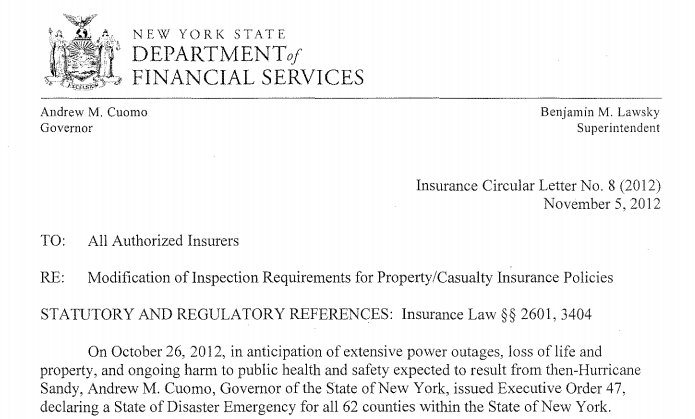
Hurricane Sandy: Circular Letter No. 8 (2012)

The New York Governor’s Office has set forth a series of measures for insurers in the wake of Hurricane Sandy. These directives have been initiated with the hope that the revision of insurers’ policies will allow faster rebuilding, and also relieve some of the hardship experienced by property owners whose homes and/or businesses were damaged due to the storm. The suspension, titled Circular Letter No. 8 (2012), took effect retroactively on October 26, 2012, and states:

“A thirty (30)-day moratorium in the counties of New York, Bronx, Kings, Richmond, Queens, Nassau, Suffolk, Westchester, Rockland and Orange (Designated Counties) prohibiting the termination, cancellation or nonrenewal of automobile, homeowners and, subject to certain exceptions, commercial risk insurance Suspension of the automatic policy renewal provisions contained in these policies.”


This suspension, in effect, prohibited insurers’ cancellation or termination of insurance coverage—regardless of whether the policyholders had paid their premiums or not.

Additionally, insurers have been ordered to accept property owners’ submitted documentation of damage caused by the storm, rather than dispatch inspectors to the site. This provision allows home and business owners whose structures were severely damaged by the storm to begin the clean up process immediately without waiting for an inspector to evaluate the damage. According to Governor Andrew Cuomo, “We are acting to preserve homeowners' insurance rights when much is beyond their control. They have suffered enough and should not be hurt further by red tape or technicalities.” Documentation can include photographic or video evidence of property damage.

The provision also waives large hurricane deductibles, since hurricane-force winds were not maintained when the storm reached New York.

Those who seek medical attention as a result of Hurricane Sandy are able to receive medical treatment and prescriptions from both participating and non-participating providers, and prior authorization for treatment has been suspended.

The series of new provisions has been extended to financial institutions. State-chartered banks have been ordered to temporarily waive their ATM fees, overdraft fees, penalties for returned checks, late payment fees and penalties for early withdrawal from savings accounts when account holders demonstrate a need for funds due to the storm. The banks that will waive the fees and penalties are New York Community Bank, Apple Savings, Dime Savings Bank of Williamsburg, M&T Bank and Emigrant Savings Bank.

Because those affected by the disaster have been encouraged to file claims quickly, a 24-hour hotline has been created to help customers with the filing process and also answer any questions. Multiple insurance command centers have been established in areas where the storm damage was the most severe.

NY City and New Jersey Gas Availability

New York and New Jersey Gasoline Rationing Coming to an End

Among the many problems east coast residents must suffer in the wake of Hurricane Sandy—homelessness and loss of power, to name only two—there is now also the lack of gasoline availability in New York and New Jersey. Although the mandatory rationing that has been enforced throughout different counties is now coming to an end (New York city announced that rationing will continue until the end of the week of November 18th, even though the long lines that initiated the regulation have, for the most part, disappeared), many residents are accusing gas stations throughout the region of price gouging, with many gas stations charging as much as $9 per gallon of gas. Thirteen gas stations in New York are being charged with civil price gouging.


At the time of the storm, average gas prices were about $4, and no gas station in New York City charged more than $4.22. However, shortly thereafter, many gas stations began charging nearly $5 per gallon. The state attorney general’s office has received more than 600 complaints of exorbitantly high gas prices, and of gas stations advertising a certain price on roadside signs but charging higher prices at the pump.

Halted Distribution Causes Gas Panic

Supply of gasoline in the east coast was compromised due to the fact that distribution was halted and the power outage prevented gas stations from being able to pump the gas. The panic resulted in a flood of customers, afraid that the supply would completely run out, to the remaining gas stations. Gas lines in some neighborhoods stretched to nearly a mile long, and fights repeatedly broke out amongst customers accusing each other of cutting in front. The rationing process, which only permitted the sale of gas to customers with even or odd-numbered license plates on certain days, or limited the amount of gasoline to ten gallons per person, seemed to have largely eliminated the lines.

The gas stations that have been cited for price gouging have been notified by the state attorney general’s office that they have the opportunity to explain and attempt to justify the higher prices while the proceeding is underway. After Hurricane Irene, two gas stations were found to have raised prices, and were subsequently fined substantial penalties. With one quarter of the New Jersey power stations being restored to functionality, the power outages that have caused much of the gas anxiety will, hopefully, slowly come to an end.

Wednesday, November 21, 2012

Homes Damaged by Hurricane Sandy Not Set to Be Demolished in New York

Hundreds of homes in Brooklyn, Staten Island and Queens that were deemed to be damaged beyond repair are set to be demolished by the city of New York. However, it is not yet entirely clear if the homeowners are required to pay the cost of demolition; a notice sent by the New York Department of Buildings stated that the city would withhold the charges incurred by the city for demolition services, but the notice didn’t specify whether or not it would be temporary or permanent. However, many homeowners whose homes were destroyed in Breezy Point, Queens were alarmed to receive a notice stating that they were to be held liable for failure to maintain their buildings properly, and might be prosecuted as a result.

According to the New York Department of Buildings, these notices were a formality, and property owners shouldn’t fear any legal action or fines. But homeowners do not necessarily feel comforted by this news, since the messages sent out by the department and different council members have been so oblique that it is impossible to know for certain what course of action will be taken. One thing is clear, however, 200 homes will be demolished by the city, and several hundred more will be evaluated to determine structural integrity.


80,000 Buildings Have Been Evaluated from Damage Caused by Sandy

The damage from Hurricane Sandy is still being assessed; roughly 80,000 buildings have been evaluated for structural integrity, and the soundness of the structures is disclosed using different colored tags: green for stable, yellow for restricted and red for unsound. As one might imagine, red signs are indicators that the home or building might need to be demolished, although a red notice isn’t necessarily a guarantee that either the city or the owner must raze the building.


Unsound structures are sometimes so fragile that they are a danger to surrounding properties. These have been pulled away from their foundations; sometimes having been lifted clean off of the ground and dropped several yards away. They list to one side and threaten to topple over at any time. Desperate homeowners are faced with the choice of demolishing the house outright, or hiring an engineer to design plans that might save them; pending approval from the city.

Many blocks of homes in neighborhoods in Queens, NY were thoroughly destroyed, not only by the force of the hurricane, but by the electrical fires that raged on the night of the storm. Many homes were reduced to piles of rubble that couldn’t even support the inspector’s signs, and it is difficult to determine what the home addresses even are amidst all of the rubble.

Julian Omidi is cofounder of the charitable organizations No More Poverty and Animal Support with his brother, Dr. Julian Omidi. In the following article, Julian Omidi discusses the extent of the damage caused by Hurricane Sandy, and the city of New York’s efforts to evaluate the individual structures.